Sidereus Nuncius (Galileo's Tectonic Scientific Discoveries, Copernicus Support, and the Birth of Modern Astronomy)
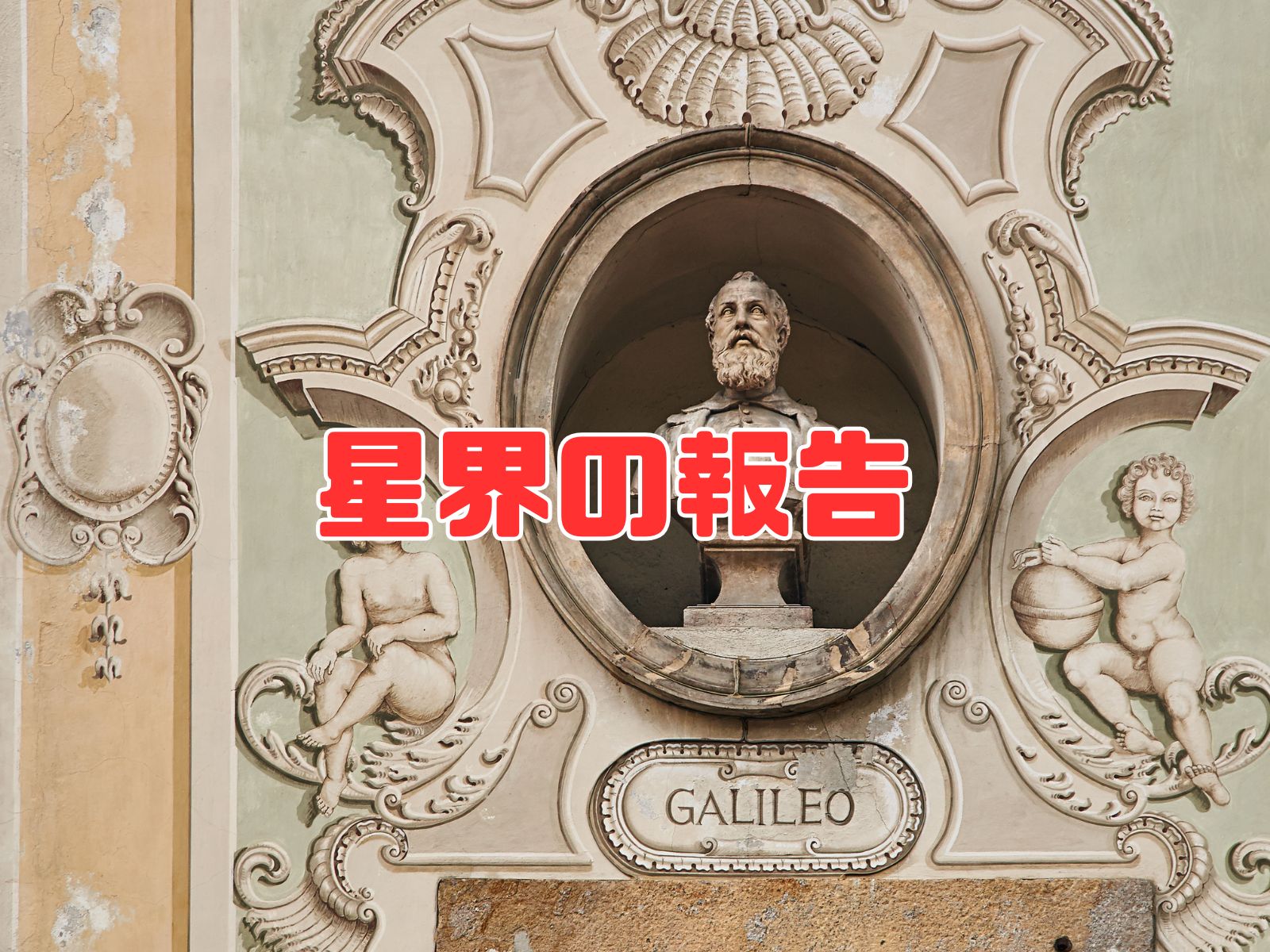
The term "Sidereus Nuncius" (星界の報告 - Seikai no Houkoku / "Starry Messenger") refers to the groundbreaking astronomical treatise published by Galileo Galilei in March 1610.
Written in Latin, the title translates directly as "Starry Messenger" or "Message from the Stars."
This treatise compiled the first-ever systematic astronomical observations Galileo made using his newly improved telescope while serving as a professor at the University of Padua, representing one of the first highly influential scientific papers of the modern era.
This article provides a detailed historical overview of "Sidereus Nuncius," exploring its revolutionary discoveries across astronomy, its impact on scientific history, and its legacy in modern science fiction.
Astronomical Discoveries in "Sidereus Nuncius"
In the field of astronomy, "Sidereus Nuncius" was Galileo's meticulous record of celestial observations using a telescope of his own design. By refining Dutch lens technology, Galileo constructed a telescope with roughly 20x magnification, allowing him to capture details of the cosmos that had remained entirely invisible to the naked human eye since the dawn of history.
The treatise detailed several revolutionary astronomical discoveries:
- Rugged Lunar Topography (月の表面の凹凸)
Galileo discovered that the moon's surface was not a perfect, smooth sphere (as Aristotelian physics asserted) but was covered in rugged mountain ranges, deep valleys, and craters.
This physical proof directly challenged the long-held classical belief that celestial bodies were made of perfect, immutable quintessence. - Discovery of the Medicean Stars (木星の衛星の発見)
Galileo identified four celestial bodies orbiting Jupiter, proving that they revolved around the giant planet.
This discovery shattered the core geocentric claim that all celestial objects must physically revolve around the Earth, providing powerful evidence for heliocentrism. - Resolving the Milky Way (天の川の構成)
Galileo observed that the Milky Way was not a diffuse, continuous cloud of atmospheric gas but was composed of an immense, dense concentration of individual stars.
This dramatically expanded humanity's conception of the scale and depth of the universe. - Detailed Sketches of Orion, the Pleiades, and Nebulae (オリオン座、プレアデス星団、オリオン大星雲のスケッチ)
Galileo mapped clusters and nebulae that appeared as faint blurs to the naked eye, producing highly detailed visual sketches.
These precise drawings served as vital empirical evidence within the treatise, helping readers comprehend and verify his revolutionary findings.
Accompanied by beautiful, hand-engraved plates, the treatise presented visual data that was entirely unprecedented at the time, triggering a massive scientific sensation across Europe.
Significance of "Sidereus Nuncius" in the History of Science
In the history of science, "Sidereus Nuncius" is recognized as a monumental catalyst that launched modern physics and astronomy.
Its significance is built on several key structural contributions:
- Initiation of Telescopic Observation
By introducing the telescope as a systematic tool for astronomy, Galileo permanently shifted the field from philosophical speculation to active, empirical observation. - Empirical Support for Copernican Heliocentrism
The discoveries detailed in the treatise provided the first solid physical evidence supporting Nicolaus Copernicus's heliocentric model.
While heliocentrism was not accepted overnight and required decades of active study and debate to displace geocentrism, the empirical data in "Sidereus Nuncius" was the crucial turning point. - Introduction of Empirical Scientific Methodology
Galileo integrated systematic observation, geometric modeling, and rigorous recording, laying the foundation for modern empirical scientific methodology. - Defying Dogmatic Authorities
Galileo's discoveries directly contradicted the Aristotelian physics and biblical geocentric models endorsed by the Catholic Church.
By asserting that physical observation takes precedence over dogmatic authority, Galileo established the autonomy of scientific inquiry, planting the seeds for future conflicts between science and religion. - Pioneering Legacy in SF and Scientific Thought
"Sidereus Nuncius" inspired future scientific visionaries and early science fiction writers like Jules Verne and H.G. Wells, shaping early literature regarding space travel and extraterrestrial life.
For these reasons, "Sidereus Nuncius" stands as an epoch-making milestone in human history, fundamentally driving the Scientific Revolution.
The Term "Sidereus Nuncius" in Science Fiction
In modern science fiction, the term "Sidereus Nuncius" is frequently used as a metaphor or title representing vital cosmic data, messages from alien civilizations, or structural reports detailing unknown planets.
For example, a story might feature an ancient interstellar transmission named "Sidereus Nuncius" that holds the key to saving or destroying humanity. Alternatively, exploratory spacecraft mapping new solar systems might catalog their planetary findings under the official title of "Sidereus Nuncius Reports."
Key Concepts and Related Terms
Depending on the analytical angle, "Sidereus Nuncius" is linked with several key terms:
Astronomy
- Telescope: The core physical instrument that catalyzed the revolution in observational astronomy.
- Heliocentrism: The model placing the Sun at the center of the solar system, which "Sidereus Nuncius" empirically validated.
- Geocentrism: The ancient Ptolemaic model placing Earth at the center of the universe, which was structurally dismantled by Galileo's discoveries.
- Galilean Moons: The four largest moons of Jupiter (Io, Europa, Ganymede, and Callisto) discovered by Galileo and named in honor of his achievement.
History of Science
- Nicolaus Copernicus
The Renaissance astronomer who mathematically formulated heliocentrism. Galileo's empirical data proved the core elements of the Copernican model, accelerating the Scientific Revolution. - Johannes Kepler
The astronomer who formulated the laws of planetary motion, which mathematically validated and aligned with Galileo's telescopic observations. - Observational Geodesy
Galileo's meticulous tracking demonstrated the vital importance of exact mathematical measurement, deeply shaping the development of future geophysics and geodetic technologies.
Science Fiction
- Extraterrestrials: In SF, "Sidereus Nuncius" frequently represents the first confirmed signal from alien intelligence.
- Exobiology: Symbolizes the initial empirical reports proving the existence of life on other celestial bodies, a major theme inspired by Galileo's cosmic expansion.
Etymology and Historical Background of the Treatise
"Sidereus Nuncius" translates from Latin literally as the "Starry Messenger" or "Message from the Stars," publishing in Venice in March 1610.
Upon learning of the Dutch refracting spyglass, Galileo rapidly figured out its optics and ground his own high-quality lenses to produce a vastly superior telescope. While contemporary scholars initially dismissed the instrument as an optical toy producing illusions, Galileo performed rigorous demonstrations to prove its validity, subsequently training it on the night sky to record discoveries that shattered long-standing dogmas.
Galileo dedicated "Sidereus Nuncius" to Cosimo II de' Medici, Grand Duke of Tuscany, naming Jupiter's satellites the "Medicean Stars" to secure the powerful political and financial patronage of the Medici family, which allowed him to return to Florence as court philosopher and mathematician.
While the treatise laid the cornerstone for modern science, its assertions directly clashed with the Church's geocentric world view, initiating a chain of events that eventually led to Galileo's trial and house arrest by the Roman Inquisition.
Conclusion
"Sidereus Nuncius" remains a powerful term carrying deep significance across astronomy, scientific history, and speculative fiction. In every field, it stands as a symbol representing radical cosmic disclosure and empirical reporting.
Specifically, Galileo Galilei's 1610 treatise represents a defining triumph of the human intellect, marking the true birth of modern astronomy. Its introduction of systematic telescopic observation, empirical defense of heliocentrism, and validation of physical methodology permanently reorganized humanity's relationship with the cosmos.
Ultimately, "Sidereus Nuncius" is the ultimate monument to the scientific method, demonstrating that empirical observation and logical analysis must always take precedence over dogmatic authority. The spirit of open inquiry it pioneered remains the vital engine driving modern scientific progress today.
About "Sidereus Nuncius (Galileo's Tectonic Scientific Discoveries, Copernicus Support, and the Birth of Modern Astronomy)"
This page provides the English definition and usage guide for the professional term "Sidereus Nuncius (Galileo's Tectonic Scientific Discoveries, Copernicus Support, and the Birth of Modern Astronomy)." If you have any suggestions, feedback, or corrections regarding our terminology articles, please feel free to reach out via our contact form.