Yoshiwara Saiken (The Comprehensive Guidebooks to the Yoshiwara Pleasure District)
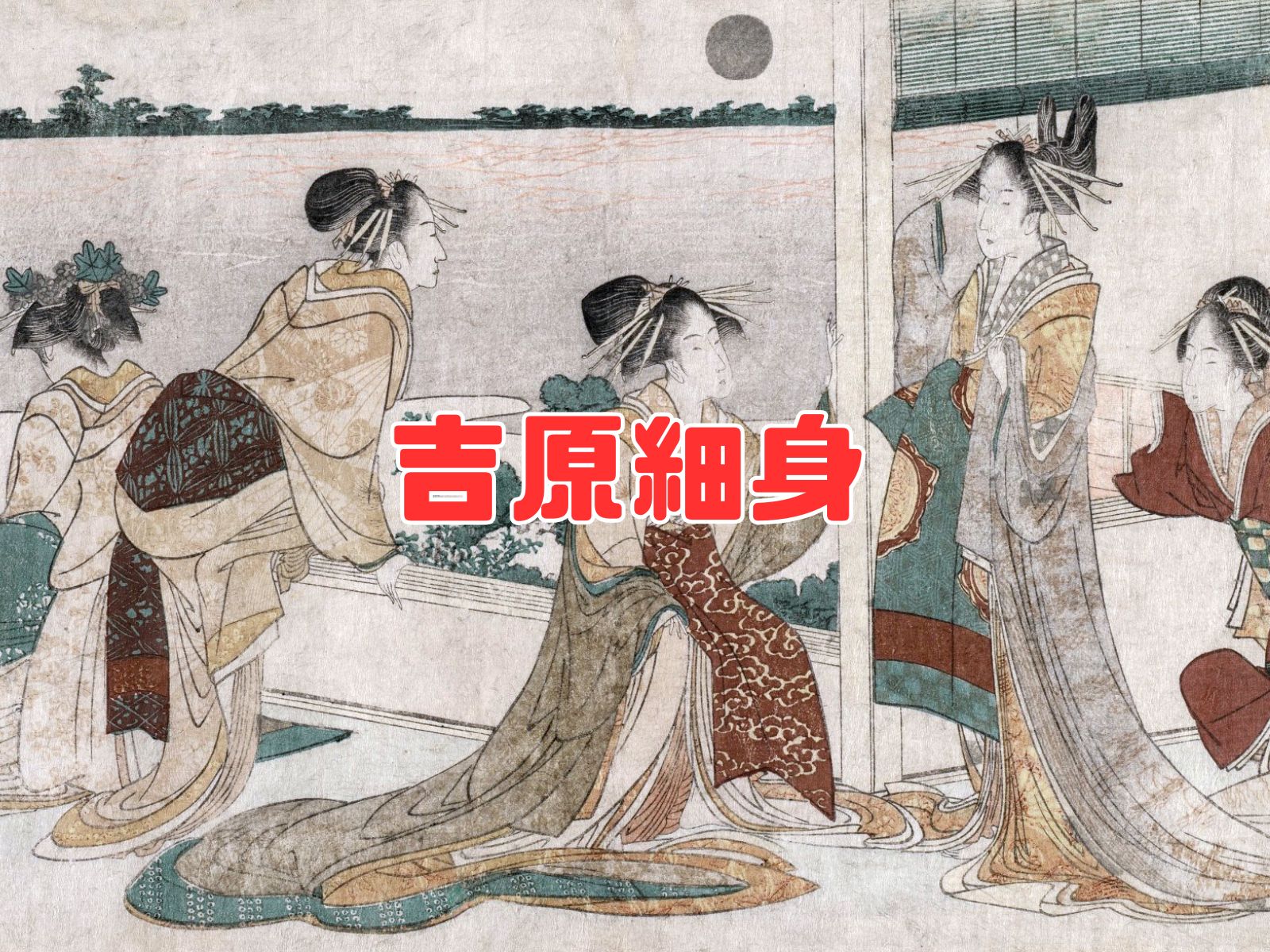
"Yoshiwara Saiken" (吉原細身 / 吉原細見) was a series of comprehensive guidebooks to the Yoshiwara pleasure district during the Edo period.
Although similar documents existed since the 17th century, they became biannual periodical publications around 1732 and continued to be published for approximately 160 years until the 1880s.
The Yoshiwara Pleasure District: A Officially Sanctioned Space for Amusement
During the Edo period, the Tokugawa Shogunate officially sanctioned only three red-light districts (Yukaku) across Japan: Shinmachi in Osaka, Shimabara in Kyoto, and Yoshiwara in Edo.
For the purposes of public security, regulation, and taxation, these districts were situated on the peripheries of major cities. They were enclosed by moats and high walls to physically segregate them from the outside world.
Among these, the Yoshiwara district was by far the largest, with several thousand courtesans (Yujo) working there at its peak.
Yoshiwara functioned as the premier social salon for men and played a central role in shaping Edo's urban culture.
The Yoshiwara district was originally established in 1617 near Nihonbashi (present-day Nihonbashi-Ningyocho, Chuo Ward). However, following the Great Fire of Meireki (1657), it was relocated to Nihontezi, behind Senso-ji Temple in Asakusa (becoming "Shin-Yoshiwara").
Before the Meireki fire, the district spanned a square of about 220 meters on each side. Following its relocation, it expanded to approximately 220 by 330 meters, growing to 1.5 times its original size.
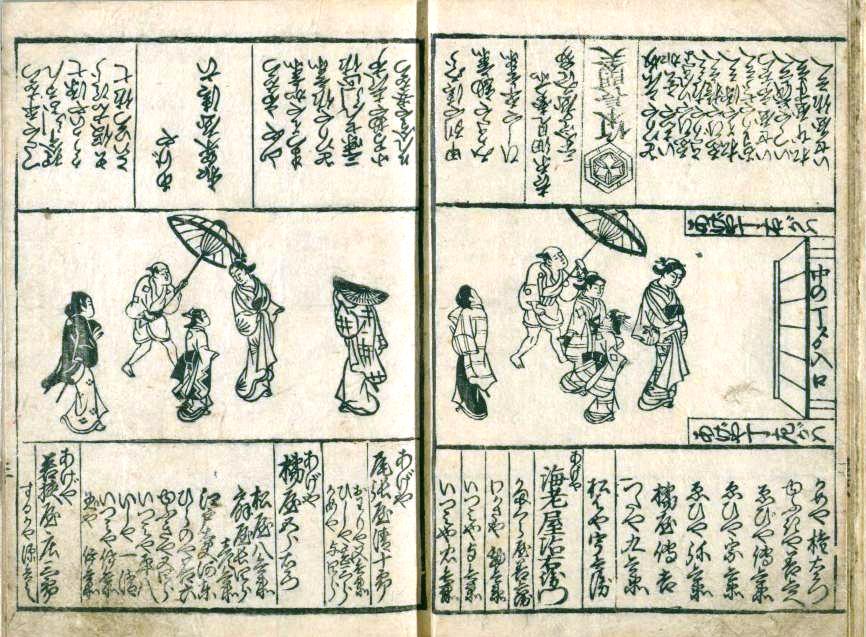
Shin-Yoshiwara was surrounded by a moat called the "Ohaguro-dobu" (black-tooth moat). Entering through the sole entrance, the Daimon (Great Gate), visitors were greeted by the main street, Naka-no-cho.
Naka-no-cho was lined with Hikite-chaya (intermediary tea houses) that guided clients to high-class brothels.
The brothels (Yujoya) faced streets intersecting Naka-no-cho at right angles, strictly classified by size and status into O-mise (large), Naka-mise (medium), and Ko-mise (small).
At the end of Naka-no-cho stood an area known as "Suido-jiri," which featured a large bronze lantern called "Akiba Jotomyo," dedicating prayers to Akiba Gongen, the deity of fire prevention.
Given the high frequency of fires in Yoshiwara, this highlighted the community's rigorous emphasis on fire prevention and safety.
The Karitaku System: Temporary Relocation During Fires
Throughout its history, Yoshiwara was repeatedly devastated by fires.
During the roughly 100-year span from 1768 to 1866, at least 18 major fires were officially recorded.
Remarkably, at least 10 of these fires are believed to have been started by the courtesans themselves, who resorted to arson as a desperate escape from their harsh, oppressive living conditions.
During such conflagrations, courtesans were temporarily relocated outside of Yoshiwara to continue operations. This was known as the "Karitaku" (temporary housing) system.
These temporary quarters were set up in districts like Fukagawa, Ryogoku, Imado, and Sanya. Fukagawa and Ryogoku, which already hosted unlicensed red-light districts (Okabasho), were particularly well-suited to accommodate the displaced courtesans.
The Courtesans: Women Who Defined Yoshiwara
A wide array of women worked under varying ranks within the Yoshiwara district.
Courtesans were typically sold to the district at a young age from impoverished rural villages, either to reduce the number of mouths to feed or to secure loans for their parents' debts.
It is believed that red-light districts were historically built near waterways, rivers, and bridges partly to facilitate the covert water transport of these women from impoverished regions.
They began their careers as young apprentices known as Kamuro and gradually rose through the ranks.
Courtesans were strictly categorized into ranks such as Tayu, Koshi, Tenjin, Sancha, and Kiri-mise.
In later years, new classifications like Yobidashi, Chusan, and Tsukemawashi emerged.
The Tayu represented the absolute pinnacle of courtesans, requiring clients to spend astronomical sums to secure their company.
Koshi awaited clients behind the wooden lattices of the brothels, while Tenjin was the equivalent rank to Koshi in the pleasure districts of the Kansai region.
Sancha represented courtesans catering to the general public, while Kiri-mise was the lowest and most affordable tier.
| Rank | Description |
|---|---|
| Tayu | The highest rank of courtesan. Highly educated in the arts. |
| Koshi | Courtesans who awaited clients behind wooden lattices (Mise). |
| Tenjin | The Kansai equivalent to the Koshi rank. |
| Sancha | Popular, mid-tier courtesans accessible to commoners. |
| Kiri-mise | The lowest rank of courtesan, working in cheap, small quarters. |
| Yobidashi | Top-tier courtesans summoned through teahouses. |
| Chusan | A high-class ranking below Tayu. |
| Tsukemawashi | Courtesans assigned directly to regular clients. |
Beyond hosting banquets and sharing quarters, high-ranking courtesans were expected to be exceptionally refined in classical literature, poetry, calligraphy, and tea ceremony, acting as elite hostesses.
Celebrated courtesans were immortalized in Ukiyo-e woodblock prints and became heroines in Kabuki plays, serving as cultural icons for the people of Edo.
Yet behind this glamorous façade lay a brutal reality.
They faced severe hardships, including substandard food, violent discipline, and rampant diseases.
Courtesans who grew old or remained poor were forced to work in the lowest-tier brothels along the moat (known as Kashi-mise), spending their final days in miserable, damp quarters facing the Ohaguro-dobu.
The Supporting Staff of Yoshiwara
Brothels employed a diverse array of specialized staff to manage operations.
For instance, the elder hostesses known as "Yarite" supervised the courtesans, younger trainees (Shinzo), and apprentices (Kamuro).
Usually former courtesans themselves, Yarite were indispensable to operations, handling courtesan education, customer relations, and mediating disputes between clients and courtesans.
On the other hand, the brothel owners, often satirized as "Bohachi" (忘八—meaning those who forgot the eight Confucian virtues), faced rigorous economic and management demands.
Additionally, "Miseban" assisted courtesans during their formal street processions (Oiran Dochu), carrying box lanterns at the front or holding long parasols over the courtesans.
Behind the scenes, "Nezuban" (night watchmen) supported daily operations by refilling lantern oil, maintaining security, and announcing the hours throughout the night.
Yoshiwara Saiken: The Guidebook and Information Magazine
The Yoshiwara Saiken (吉原細身 / 吉原細見) was the definitive guidebook to the Yoshiwara pleasure district during the Edo period.
While maps and lists existed in the 17th century, the Saiken became a highly organized, biannual publication from around 1732, continuing for 160 years until the 1880s. Following the Yakusha Hyobanki (actor directories), it stands as the second longest-running periodic publication in Japanese history.
Sold by specialized street vendors within the district, the Saiken contained detailed street maps, brothel directories, courtesan names, pricing lists, tea houses, boat operators, and geisha rosters.
Originally evolving from the Kana-zoshi style yujo directories, it flourished during the Kyoho era (18th century), gradually shifting from opinionated reviews to highly practical, data-rich information magazines.
The format of the Saiken evolved continuously to match changing printing styles and formats.
Single-sheet broadsides appeared during the Enpo era (1673–1681), and by the Genroku era (1688–1704), courtesans were systematically cataloged by rank.
During the Kyoho era, the influential publisher Tsutaya Juzaburo introduced folding accordion-style books (Orihon), followed by horizontal (Yokohon) and compact vertical formats (Tatehon). By the Meiji period, some editions even integrated early photographs of the courtesans.
Yoshiwara Saiken and Edo Culture
The Saiken mirrored contemporary trends, fashion, and language.
For example, the popular masculine fashion style known as "Inase" (chic/gallant), which emphasized a slender, sleek silhouette, is believed to have been heavily influenced by the aesthetic standards set by Yoshiwara courtesans.
Furthermore, the Saiken functioned as an early marketing and promotional tool. Courtesans paid placement fees to have their names and artistic profiles featured prominently, aiming to attract wealthier clients.
However, from the late Tokugawa shogunate into the Meiji Restoration, the quality of the Saiken declined, featuring cruder prints and less reliable directories, reflecting the gradual decline of the traditional Yoshiwara district during a period of rapid modernization.
Cultural Significance of Yoshiwara Saiken: Modern Perspectives
Far from being mere commercial directories, the Saiken serve as invaluable historical artifacts for understanding Edo-period culture.
They provide precise data regarding Courtesan hierarchies, linguistic trends, economic fluctuations, and print technology of the era.
Furthermore, the Saiken held deep connections with Ukiyo-e prints and Kabuki theater, making them essential for understanding the broader fabric of Edo art.
In modern times, these guidebooks serve as key references for historical research, literature, theater, and fine arts.
For example, the courtesan names and directories recorded in the Saiken help novelists and directors reconstruct authentic historical settings.
Classic films like "Yokiro" or "Yoshiwara Enjo" drew heavily on these directories to ensure historical accuracy, while the illustrations in the directories remain a key subject in art history studies.
Moreover, the Saiken provides fascinating insights for modern discussions on sexual labor and gender dynamics.
While Yoshiwara was undeniably a site of severe female exploitation, high-ranking courtesans also pursued high levels of artistic independence and financial self-determination. The Saiken allows modern scholars to analyze the agency and complex societal roles of these historical women.
Conclusion: Deciphering Pleasure District Culture Through the Saiken
The Yoshiwara Saiken is a meticulous historical record detailing Edo's pleasure quarter.
Spanning maps, rankings, prices, and artistic profiles, it remains an indispensable resource for exploring pleasure quarter culture, offering deep insights into the social hierarchy, artistic trends, and daily lives of Edo-period women.
The directories also reflected the complex socio-economic structures of the Edo period.
By illustrating the state-sanctioned licensing, rigid class rankings, and commercialized entertainment, they provide a window into the Shogunate's regulatory systems. While participating in the commodification of women, the Saiken also elevated Courtesans into cultural icons, embedding pleasure district trends into mainstream Edo society.
Today, the Yoshiwara Saiken continues to support diverse academic research across history, culture, and gender studies. Its detailed pages not only illuminate the past but also offer valuable context for reflecting on contemporary issues surrounding labor, media, and gender.
About "Yoshiwara Saiken (The Comprehensive Guidebooks to the Yoshiwara Pleasure District)"
This page provides the English definition and usage guide for the professional term "Yoshiwara Saiken (The Comprehensive Guidebooks to the Yoshiwara Pleasure District)." If you have any suggestions, feedback, or corrections regarding our terminology articles, please feel free to reach out via our contact form.