Aobon (Edo Period Woodblock-Printed Illustrated Books)
"Aobon" (青本—literally "blue/green books") refers to a genre of woodblock-printed illustrated storybooks (Kusazoshi) that flourished during the mid-Edo period.
Kusazoshi represent the historical precursors to modern Japanese manga, combining sequential illustrations with integrated text.
As the name implies, Aobon were distinguished by their light-green (Moegi-iro) covers.
However, due to centuries of natural pigment degradation, most surviving copies now appear yellowish in color.
Emerging after the child-oriented Akabon (red books) which dominated the Kyoho era (1716–1736), Aobon appeared concurrently with Kurobon (black books) from around the Enkyo era (1744–1748) to the An'ei era (1772–1781).
Unlike the simple Akabon, Aobon incorporated complex narratives geared toward adolescents and adults, sharing a similar readership with Kurobon.
In the history of Edo popular literature, Aobon played a vital bridging role between early folk tales and the sophisticated, satirical Kibyoshi (yellow-covered books) that followed.
Historical Background
The mid-Edo period was characterized by robust economic growth and the flourishing of commoner culture (Chonin bunka).
With rapidly rising literacy rates, the demand for affordable, entertaining reading materials surged, allowing Kusazoshi to spread as popular entertainment across all social classes.
When Aobon first appeared during the Enkyo era, Kurobon were the dominant style, but by the latter half of the 18th century, Aobon surpassed them in publication volume.
This shift occurred because Aobon developed a reputation for witty, lighthearted, and highly entertaining storytelling.
This transition in popularity from Kurobon to Aobon highlights a shift in Edo reading habits, as audiences increasingly favored breezy, easily accessible, and humorous narratives.
The development of Aobon was also significantly influenced by Chinese colloquial fiction (Baihua novels).
The influx of Chinese popular genres—such as mystery, ghost stories, and erotic art—sparked translations and creative adaptations, giving rise to new literary formats like Aobon.
Furthermore, the spread of local temple schools (Terakoya) greatly enhanced the literacy rate of commoners.
As more citizens learned to read and write, books became standard household items, cementing reading as a mainstream leisure activity.
The printing and distribution of Aobon were driven by specialized publishers known as "Jihon-toya."
They managed everything from illustration commissions to printing and retail, distributing Aobon nationwide to make them highly accessible to the public.
By the Horeki era (1751–1764), Aobon began integrating proto-satirical elements, and by the end of the Meiwa era (1764–1772), they fully evolved into the style and format of Kibyoshi. This transition was driven by both shifting reader preferences and the expanding creative ambitions of the authors.
Content and Characteristics of Aobon
Aobon primarily featured illustrated summaries and dramatic adaptations of Kabuki and Joruri theater plays. However, the genre also spanned historical epics, martial legends, traditional fables, and supernatural ghost stories.
Key structural characteristics of Aobon include:
- Illustration-Centric Layout
Illustrations dominated each page, with brief text blocks written in simplified Hiragana nestled around the characters. A typical page layout utilized two-page spreads to depict a single dramatic scene, utilizing dynamic character movement and facial expressions to visually immerse the reader into the story. - E-daisen (Illustrated Title Slips)
The front covers featured specialized, beautifully illustrated title slips known as E-daisen. Much like modern book jackets, these slips visually advertised the content of the book, effectively driving sales. - Accessible Narratives
By minimizing complex Kanji and specialized vocabulary, Aobon ensured their contents were easy to digest, catering to young readers and those with basic literacy. - High Entertainment Value
Focusing on comedic plots and moral tales of poetic justice, Aobon provided lighthearted escapism, helping urban commoners unwind from daily labor. - Nakamoto Format
Typically published in booklets of 5 sheets (10 pages) each, a complete story would be published across a series of several booklets. This modular system kept production costs low, making books affordable for the masses.
Famous woodblock artists such as Torii Kiyotsune, Tomikawa Ginsetsu (Fusa-nobu), and writer Kansuido Joa were heavily involved in Aobon production.
Their distinct artistic styles drove the popularity of the genre. For instance, Torii Kiyotsune was celebrated for his bold lines and dynamic portrayal of actors, while Tomikawa Ginsetsu specialized in elegant, delicate brushwork depicting graceful female figures.
Prominent Examples
Notable examples of Aobon literature include:
- Furyu Kantan Ukiyo Eiga Makura: Written by Kansuido Joa. An adaptation of the classic Chinese philosophical tale "Kantan" (The Pillow of Kantan).
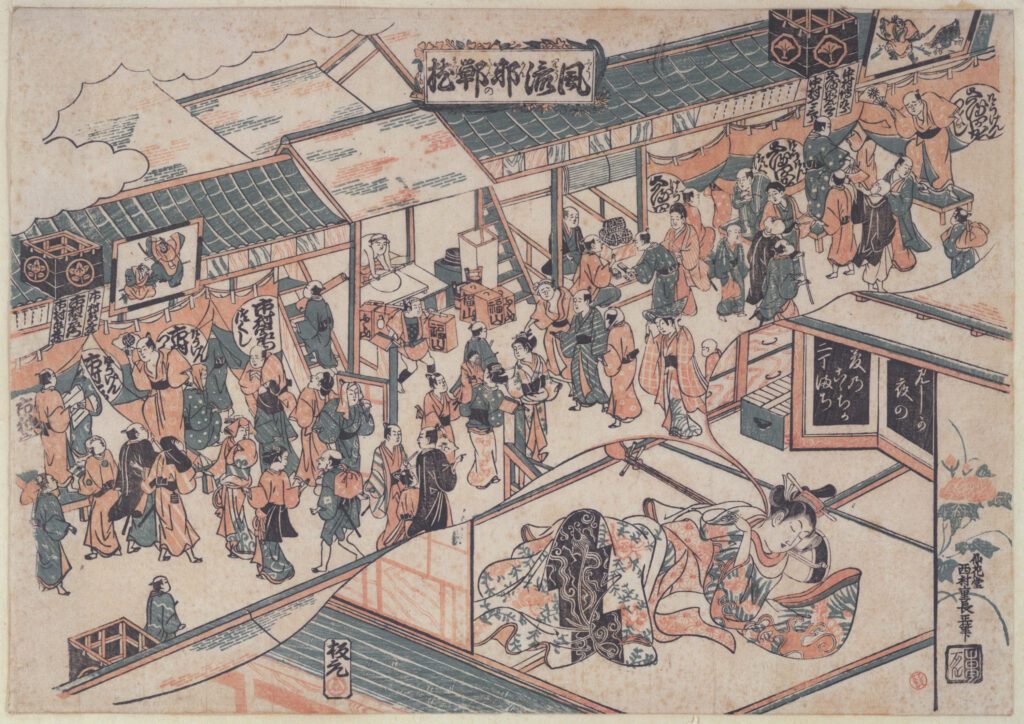
- Furyu Sennin Hanamuko: Author unknown. A dramatic illustrated story based on popular Kabuki theatrical plays.
Relationship with Sharebon
The humor and dialogue-driven nature of Aobon directly influenced the rise of Sharebon (洒落本)—witty, satirical books set in the pleasure districts.
Sharebon captured the sophisticated dialogue, fashion, and customs of red-light districts, acting as romantic short stories of Edo Japan.
The comedic timing and textual formatting developed in Aobon were absorbed into Sharebon, shaping the trajectory of subsequent Japanese popular literature.
Legacy in Modern Media
As a cornerstone of Edo-period print culture, Aobon laid the foundations for modern Japanese manga and sequential art.
- Sequential Visual Storytelling
Much like modern manga, Aobon blended text and image to guide readers through a narrative. Early iterations of panels, word bubbles, and visual onomatopoeia can be traced back to these woodblock-printed pages. - Focus on Public Entertainment
Like modern pop culture, Aobon prioritized engaging the public, delivering humor, thrills, and emotional resonance to help urban commoners relieve stress. - Enriching Mass Culture
As historical bestsellers, Aobon elevated public literacy and cultural engagement. Their visual grammar and narrative techniques went on to influence master artists like Katsushika Hokusai and eventually 20th-century manga pioneers like Osamu Tezuka. - Visual Storytelling Techniques
By prioritizing illustration over blocks of text, Aobon refined visual storytelling. They utilized character expressions, postures, and detailed background details to foster reader empathy. The dynamic action staging and subtle emotional close-ups in modern shonen and shojo manga represent the natural evolution of these Edo-period woodblock techniques.
Conclusion
Aobon were a key genre of Kusazoshi during the mid-Edo period, celebrated for their light-green covers and illustration-led layouts.
By translating complex Kabuki and Joruri theater plays into accessible, visually engaging summaries, they became beloved staples of public entertainment.
Today, they serve as crucial historical links showing the evolution of Japanese visual grammar, connecting ancient scrolls directly to modern manga and graphic novels.
Beyond pure entertainment, Aobon are rich historical documents reflecting the daily lives, thoughts, and cultural trends of Edo commoners.
Through their prints, we gain insight into the jokes, fashion, and social values of the era. Their legacy in sequential storytelling remains globally visible today through modern Japanese manga and animation.
About "Aobon (Edo Period Woodblock-Printed Illustrated Books)"
This page provides the English definition and usage guide for the professional term "Aobon (Edo Period Woodblock-Printed Illustrated Books)." If you have any suggestions, feedback, or corrections regarding our terminology articles, please feel free to reach out via our contact form.